
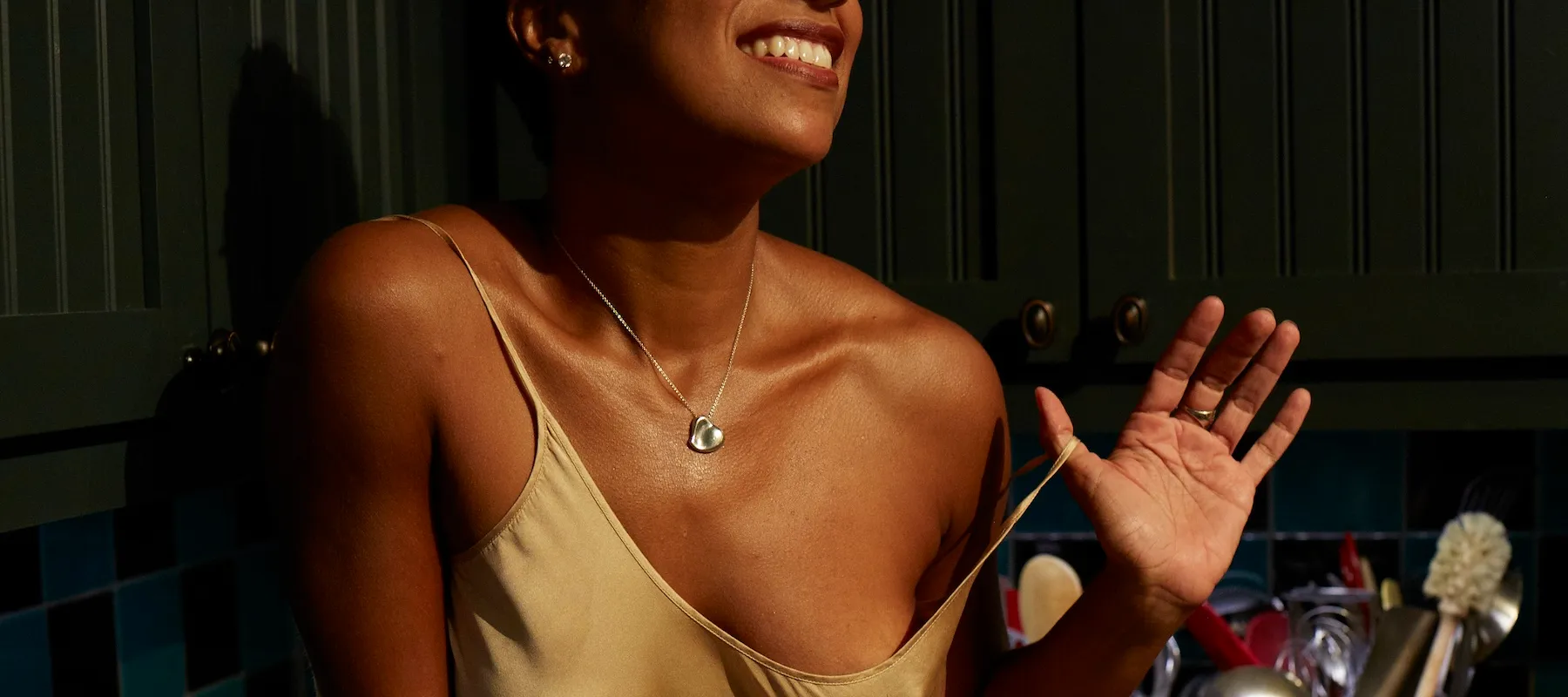
The Craft of Bondage, the Freedom to Explore
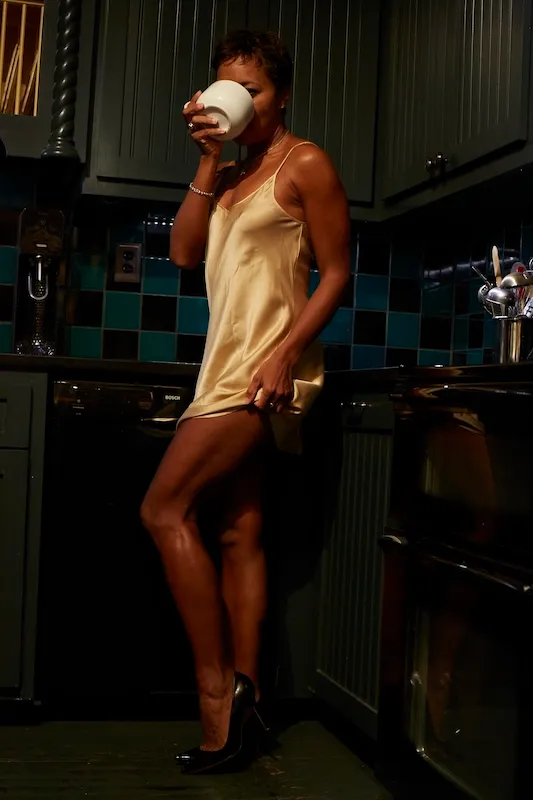
Troy Orleans is a New York City-based professional dominatrix and bondage artist with more than two decades of experience. Before entering BDSM professionally, she earned a master’s degree and worked as a journalist, including as a food writer. What began as a personal exploration became a career rooted in her enthusiasm for the technical craft, emotional connection and erotic possibilities of bondage.
At her private Manhattan studio, Salon d’Orleans, she creates immersive, personalized experiences using an extensive collection of specialist equipment and custom-built furnishings.
Her practice has been featured in Petit Mort, Vogue Italia, Maxim, and Serious Bondage, and she has discussed her work on Tina Horn’s Why Are People Into That?! andThe Masocast podcast. She has also been quoted in The New York Times andThe Establishment, sharing her perspective on restraint, desire and the experience of surrendering control.
A Plan to Be Spontaneous
CD: Troy Orleans. The myth, the legend, the icon. You have been a professional dominatrix for more than two decades. Knocking down doors so others could walk through them, this depth of experience gives you a perspective on the industry that relatively few people have.
In previous interviews and through your thought leadership, you’ve described being drawn to Domination because it was not only intellectually, emotionally, physically and sexually – erotically stimulating – but also because you love the work of learning a craft and honing a skill set.
After these many years, what does the concept of mastery actually mean to you? Is there a point where experience becomes expertise, or does expertise actually make you more conscious of how much more there is to learn?
Troy: Well, there’s that whole aphorism about the different stages of knowledge.
It says: you don’t know what you don’t know, then you know what you don’t know, eventually you know what you know, and ultimately, you don’t know what you do know.
Mastery is at the heart of “you don’t know what you know.” It’s when you become Neo in the Matrix, where you realize, “oh, it is all in me.”
CD: 10,000 hours. Muscle memory.
Troy: Yeah, muscle memory, but also an understanding of things because you have so much experience — intellectually, practically, and physiologically— that you’re able to integrate all those layers of experience and apply it in different moments.
I feel that genius is when you don’t know what you know, but you are actually able to articulate it – the ability to take your mastery, your understanding, and break it all down so that someone who doesn’t know anything about the topic will understand it more because of how you’ve presented it to them.

Troy: We’ve all had that moment when someone is mansplaining or trying to tell us about something that they do. And you’re just like, there’s nothing about how you’re telling me this that helps me learn anything, or makes it interesting. I think that’s the difference between somebody who is just talking and someone actually sharing knowledge.
But back to your question. I think that sometimes I don’t know what I know. Work is still always an exploration for me.
By exploration, I mean that I very rarely go into a scene with a fixed idea or a script; I barely go in with a plan! I tend to improvise everything that I do. Part of that reason for that is because everybody comes in with a different energy. Who we are in this very moment is different from who we are overall or how we’re gonna feel an hour from now, or tomorrow…
I want to meet the person whom I’m playing with exactly where they are in that moment and exactly where I am as well. If I had some sort of really intense, high-energy session planned and they come in saying, “I didn’t get a lot of sleep last night” or “I just need to slow down,” then I don’t have to change midstream. Instead, I can say, “What do you need today? How do you want to feel?” And then I can assess what I need to do in order to elicit that feeling from them.
CD: Has it always been that way, or do you feel that that methodology has been more accessible entirely because of the level of mastery?
Troy: I’ve always been improvisational. Always.
And I don’t know if it’s because I’m a Capricorn or maybe it’s a little bit on the spectrum or something, but I do not like changing plans and I don’t like having plans being changed on me at the last minute. So I just plan to be spontaneous when I session and I think that over time my expertise has helped facilitate that. I can roll with anything thrown my way because I have more tools in my toolkit; I have more options now.
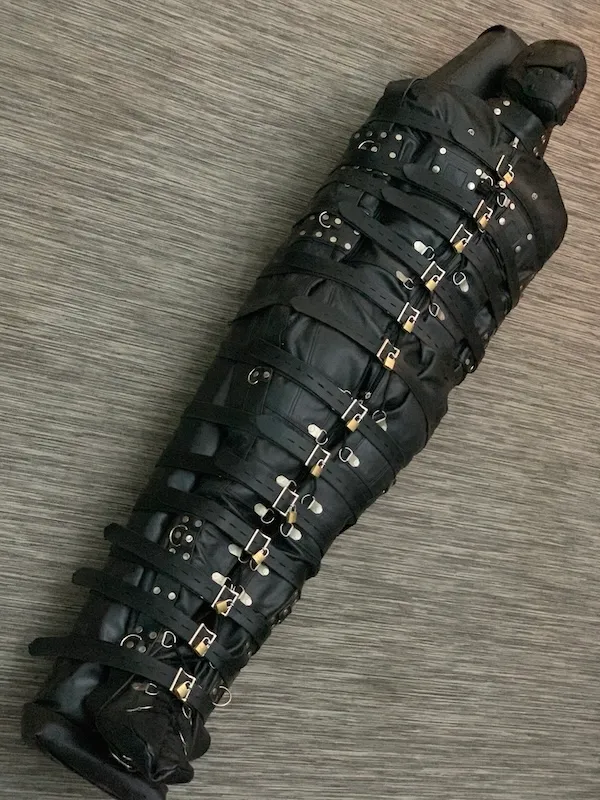
So maybe before, it’s like, oh, well, you want to feel… you want something quiet and meditative, and maybe all I knew at the original time was to wrap a bunch of saran wrap around somebody and mummify them. But now, I can say, okay, I’m gonna do a layered immobilization bondage that’s with leather, and corsets and sleep sacks and layered hoods…
Having so many more tools at my disposal because I’ve had enough years in practice to to develop those skills — and acquire the equipment! — has been a real asset for me. But, truly, the technical stuff is always exciting for me. That’s part of how I maintain my longevity: I try to pace myself. From the beginning, I wanted to take the time and learn the things that I had a genuine, organic, personal interest in, as opposed to letting client preferences dictate what type of play I should learn.
Even with bondage, where there’s a lot of stuff I know, there’s still always stuff that I’m discovering. I’ll be working with a client and be like, “Whoa, I didn’t even know I could do that,” or, “I’ve never done this before, but here we go. You ready?” That’s just delightful for me.
CD: I love that. I think it is your constitution as a lifelong learner, a gobbler of life and knowledge.
Troy: I am deeply curious.
CD: I think it is also the fact that you are a master, no pun intended, of your craft. I personally believe you need that foundation of knowledge and experience to be so agile, flexible and adaptable in the moment.
There could be the temptation in this industry, built partly around fantasy and persona, to appear fully formed. You suggest a very different model built around curiosity, study, experimentation and accumulated knowledge. How important do you think it is for emerging dommes or individuals entering or approaching this type of work to have that mindset of an apprentice of the craft?
Troy: I don’t know how important it is. I think it depends on why you’re here to begin with and what you hope to get out of it.
If you are genuinely curious about BDSM, if you are genuinely like, “Hey, I want to explore, I want to learn,” then, sure, think of yourself as an apprentice to a craft. Look for mentors, build community, develop skills to make it interesting, find out who you are in this work, and have fun with that discovery.
But there’s another way if you just have a capacity for the work, which not everybody does. There are lots of people who have a genuine interest in BDSM, but they do not have the capacity to do it professionally. It’s totally fine. Not every hobby needs to be monetized. But again, since I’m a Capricorn, I don’t know about that.
CD: That’s okay! I’m Aries, which tells me, “We gotta monetize my dog.”
Troy: Exactly. I’m like, “I have fun doing this. How can I do it more? I need to get paid while I do it. Okay, then this works.”
But I think that for people who find themselves with the capacity for this work and an affinity for it, having that persona that allows you to do the work, but also go home at the end of the day, take off the catsuit and be your regular self, that’s also a gift. It’s its own superpower, I feel.
If you want to make this a career, if you really want your work as a BDSM professional to be integrated into your life, then thinking of yourself as an apprentice to the craft helps. At least from my perspective, it helps you stay stimulated, stay engaged and have different things about the work that are bringing you joy, rather than just the money: the sisterhood, the outfits, meeting new people or whatever it might be.
CD: Latex is not generally fun to get into, so there’s gotta be a driving motivation that is larger.
Troy: Yes, I think so. If you’re going to do this, I think having as many layers or avenues of interest…
I’ve sometimes talked about being in love with someone. Rather than trying to love everything about the person all the time, I just try to find one thing about that person that I’m obsessed with. It may be something as silly as, “I love their eyebrows.” How full their eyebrows are, thick and well-defined. I can just get lost in them, watch them sleep and look at their eyebrows.
One day, I’m going to wake up and those eyebrows are not going to be doing it for me anymore. But I can then say, “You have such beautiful hands,” and be madly obsessed with their hands. Rather than feeling like I have to love everything about them all the time, I just try to be madly in love with one thing.
I think that having that kind of approach to this as a craft, as a community and as a business means you have access to always being in love with the work, even if it’s just one little bit at a time.
Hold Something for Yourself
CD: Longevity also means understanding your own limits. A sustainable career has to account for the physical stamina that I think people underestimate is mandatory for a pro domme, but also emotional boundaries, privacy, your mentality and relationship to money, consciousness of reputation, relationships with your subs and clients, and the changing methods and channels through which people find and engage with you, as you mentioned, from print onward.
Which of those dimensions do you think younger professionals are least prepared for, and which took you the longest to understand personally?
Troy: I think younger professionals are the least prepared for the physical stamina involved, probably because they have so much of it naturally. When I hear of women going balls to the wall, working all the time, working constantly, to me, that just leads to burnout.
I’ve seen so many women come in with that new girl energy, which means that they have really awful clients. The awful clients seek out the new girls because the experienced ones have all blacklisted them.
CD: It’s also, “Ooh, new and shiny!”
Troy: Exactly. Some people just like the new girls. Also, when you’re new, you don’t know what your boundaries are as well. People who have been around for a while and been blacklisted by everybody else have been blacklisted because they don’t have respect for boundaries. When you don’t know what your boundaries are, they can take advantage of you.
I think the younger ones are so excited to be working, to be in demand. They get their “Domme-initus,” the domme’s disease, where they’re like, “I am the Queen.” After a while, they get burnt out and have some kind of breakdown. Then they either quit, or they learn to pace themselves and learn that physical stamina is not the end-all, be-all. They learn how to pace themselves in every kind of way, not just in terms of how much they work, but the quality of the work they do.
For myself, I am still on a journey with emotional boundaries because I love this so much, because I care so much. In some ways, in order for me to do this well, I have to fall in love with my clients just a little bit. Their lives can sometimes literally be in my hands, and there has to be care, concern, empathy and compassion for the people I play with.
In my case, a lot of the people I play with are very much in the closet about their kink. Providing a safe space for them to express their desires, and not just express their desires, but have their desires met in an elevated way, like, “Oh, I didn’t realize that it could be like this;” I take that as an honor and a great responsibility.
What can happen in that exchange is that clients can get a little greedy or selfish. They’re so happy to have someone willing to give this attention and care to their kink that they drink my milkshake. They drink it up! Sometimes I have to be careful. I have to hold something for myself.
I’m always working to understand what my emotional boundaries are and to make sure that I match their energy, that our energy is sustainable and balanced in the container of our professional relationship. That’s been a key lesson for me to learn and bring into this.

Hotness Is Temporary
CD: The adult industry has changed dramatically over the course of your career, particularly in how individuals market themselves, create content, build audiences and turn visibility into profitable income. What do you think gets lost when visibility is mistaken for expertise?
Has maintaining a career over these decades required you to resist pressure to constantly perform yourself publicly?
Troy: Because of the way the internet and social media work, a lot of times people think, “She’s got a lot of followers, so therefore she must know what she’s doing.”
I have a very low profile on social media. Some of that’s intentional because I’m more interested in connections than I am visibility. And some of it is because, like, it takes me half a day to make a 90 second Instagram reel, you know?!
CD: But more followers means more opportunities? Don’t you wonder if you’re missing out?
Troy: It can, but I’m happy being visible enough for the right ones to find me. I’m not for everybody, but for the few that I AM right for, they’re gonna feel like they hit the jackpot! If you want a hot girl in the room with you doing sexy things to you, there are so many women who can do that. But that’s not really my…
CD: You’re a sexy girl doing bondage top work.
Troy: No, I’m a bondage top who happens to be sexy or attractive to some people. Oftentimes, I don’t feel it’s necessarily about, “I’m so beautiful,” or, “I’m so dominant,” so much as, “I’m really good at the things I do.”
Hotness is ephemeral. Hotness is temporary, but skill is a lifetime. That’s always been important to me.
There are things I’m an expert in with 20 years of experience, but there are things I do not have expertise on, even with my 20 years of experience. I am not an expert at social media. I am not an expert at being a high-visibility, high-profile person on the internet. I think I’m very good at branding, but I wouldn’t say I’m an expert at marketing.
Where visibility and expertise can be in conflict is for the person looking for expertise. They may think, “Because this person is so visible, they have the expertise,” and they might not.
If they’re presenting themselves as an all-purpose expert, they may not be the right fit for you, what you’re interested in learning and what you want to do.
I think it’s really important that when you’re a domme seeking out mentorship, training or client looking to play with a pro, it behooves you to look beyond someone’s visibility and say, “Is this person a good fit for me, a good fit for my goals?” It is absolutely fair to talk to them and ask directly, “These are the things I’m interested in experiencing,” or, “This is what I’m looking to learn.”
The hard part goes back to the whole, “you don’t know what you don’t know.” I always chuckle to myself when I see dommes saying, “I am fluent in all aspects of BDSM.”
CD: Jack of all trades, Master of none…
Troy: Right. I’ve tried a lot of things and have been around long enough to know that there are some areas of play that I don’t really understand, or fetishes I simply am not interested in and have not taken the time to learn — and I’m pretty upfront about it whenever I’m asked.
But there are many practitioners who want to cast as wide a net as possible and claim broad expertise, or at least experience, in pursuit of visibility and accessibility. I feel, however, that when you’re investing in a BDSM experience, whether as a client or when looking for mentorship/training, it’s way more important that you go to someone who is fluent in the guidance you’re trying to get.
CD: Visibility and follower numbers do not equate to authority. Nor do press bylines equate to authority. It just means that person came up as a quotable source. They may not be the most authoritative quotable source.
I think in a lot of ways in society, those who are the most visible aren’t always the ones with the real knowledge, the expertise, the craft, the art.

“Those Are My People”
Troy: I’ll talk to prospective clients sometimes who’ll say, “I’m really interested in roleplay.” That’s a big one that happens. When they come to me and say they’re into roleplay, which is not something I’m interested in, my consistent and immediate reaction is, “I don’t do roleplay.
However, if your concern is suspension of disbelief because you want to have a container to feel that this person is in control or in authority, please know you will have no doubt who’s in charge when you’re playing with me. But if you really like getting into character, the costumes of roleplay, the fantasy and the fantastic-ness of it, then GREAT! but you need to go see somebody else because that’s not what I do.
CD: It sounds like your methodology, your philosophy, is more about: what is the subtext of the interest? What is driving the psychology behind this desire? Is it indicative of something else versus the literal definition of what you’re requesting?
Troy: Even in my expertise with bondage, there are some people who like bondage because it imposes an external restriction on them, and they like pushing up against that physical boundary, especially in the absence of convincing authority from the domme. That’s also not really somebody who’s a great fit for me. I can work with it and play with it, but my ideal client is a bondage lover, period.
They love the feeling of constraint, of restraint. Even if it is something about pushing against, it is more that the bondage itself feels good to them. The way it makes them feel is important. If it’s about the feeling, then we are off to the races. If it’s rooted mostly in a power dynamic control thing…
CD: That’s something else entirely.
Troy: It’s something else. I can work with it, but at the end of the day, it may often feel like there’s something missing because I feed off of you loving the feeling that you are absolutely not in control. You cannot move. You cannot do anything.
The release that comes with knowing in your bones, in your very being, that this is where you are, and you are in it until I say otherwise. When we have that energy and that dynamic, that’s the thing that’s really exciting for me, too. That’s where I’m trying to get to.
CD: I would be such a bad sub for you. I like a weighted blanket, and that’s about it.
Troy: Well, I can definitely give you that weighted blanket feeling. That sense of being held, and even more sensorily held down. I actually like that feeling of weight on me, that kind of compression, myself. Though usually only for like five to ten minutes … then I’m tapping out! My clients, however, are usually in it for much, much longer.
On one hand, I’d be really curious to play with me, but…
CD: You would not hire *you*, is what you’re saying.
Troy: Once might be enough. I’d be like, “Okay, that was fun, that was interesting.” Or maybe I would do it once, and it would unlock something in me. I’d be like, “Actually, that was fucking awesome,” and be addicted to it. I don’t know.
My ideal folks are people who have been tying themselves up since they were five years old. They always volunteered to be captured in schoolyard games. As an adult, they secretly enjoy vanilla situations that impose confinement, sensory deprivation, restriction, or compression.
Those are my people.
CD: I get claustrophobic in Yankee Stadium, so one more reason why I will not be booking you.
Troy: Ha! That’s totally fine!
Hollywood’s Depictions of BDSM
CD: Pivoting a little bit, you and I are big film, cinema and entertainment enthusiasts. We’ve had conversations regarding representation of sex work in properties such as Euphoria or Anora.
BDSM has become a lot more visible in mainstream entertainment and pop culture, facilitating conversations like the ones we’ve had.
But visibility doesn’t necessarily produce understanding, either on the part of the creators of the piece, those acting it out on screen or those engaging with the film and seeing it.
Troy: From the creators to the performers to the consumers.
CD: When domination and submission get reduced, when it becomes reductive and is represented via totems, almost, like leather restraints, cruelty, humiliation, sexual spectacle…
Troy: There can be a huge disconnect.
CD: What do you think gets lost with the psychology and human exchange underneath it?
Are there aspects of BDSM that you think mainstream culture will have fundamental difficulty representing because they aren’t visually oriented?
Troy: It’s an interesting question. Some of what you’re talking about is that, to a certain extent, it’s a game of telephone.
You have the creator who has one particular vision. What informs their vision may be all of the stuff they’ve seen on TV before, or it may be their personal experience and interests that they’re trying to infiltrate into this story.
The actors are performers, and whether they have experience or not, it’s their job to execute the vision of the creator.
CD: It’s a manifestation of an idea.
Troy: Exactly. Sometimes whatever experience or interest the performer brings into realizing that vision may be in harmony with it, and sometimes it may contradict it. When it contradicts that vision, they still have to go with the vision, not their own thing, because that’s the job of the performer.
As consumers, we’re also stuck in the place of opening our mouths to what’s being fed to us.
CD: It’s also an attention span issue.
Troy: It can be an attention span issue, too. The other thing is the limitation of production to begin with. Kinky people will complain, “How they were tied up, that wasn’t very realistic.” But this is television, or this is film. It is not realistic for Tom Cruise to be hanging off the edge of a plane, either. But here we are.
CD: I would also say that properties or pieces of entertainment that depict stories of this nature usually have smaller budgets. They don’t have the Mission: Impossible budgets.
Troy: But even, I’m thinking of that James Bond film where Daniel Craig is tied to a chair, the seat has been ripped out, and Mads Mikkelsen is torturing him and swinging some kind of mace or something at the underside of the chair.
The way he’s tied is not any way I would secure someone I intend to torture to a chair. While the torture was delightful, and I’m still waiting for a rattan chair to come into my life so I can rip the seat out and do that myself, there’s also the safety of the actor to consider.
They’re filming this scene over and over to capture it from different angles, and it’s a stunt. You can’t actually be hitting Daniel Craig in the balls. You can’t put an actor in a constrictive, inescapable tie. There are all of these reality considerations you have to make.
Sometimes it looks realistic, but when it doesn’t, it’s because there are so many limitations to the medium, as far as what the performer is able to accomplish and the story they’re trying to tell.
Sometimes reality may be authentic, but it doesn’t make a great story. Just because it happened to you doesn’t mean it’s a good story, that it’s watchable, that it serves the plot, that it moves the action along.
It’s the same way that lawyers hate to watch law procedural shows, cops don’t like to watch cop shows, and medical doctors don’t like to…
CD: I’ve never seen Mad Men, so…
Troy: See?! If you’re actually in the industry and know how things are done, how you see that represented on screen is going to be very different from what you know is more realistic or accurate.
CD: I think people are less conscious of the fact that there is an inherent suspension of disbelief. It’s Hollywood. It’s not often accurate.
Troy: I am here for all the representation though. Let’s have more! I would rather have more so you have a whole diversity of experiences and stories being told. That way, the consumer knows, “In this show, the dominatrix wore a catsuit, spoke with a certain tone in her voice and had an evil laugh.
But in this show, a woman was sexually dominating a man with a whisper and raised eyebrow while in her gym clothes.”
We get to see the gamut of those different experiences. We are not a monolith. I am here for all of the representation, even the imperfect ones, as long as they’re doing so with a measure of responsibility.
CD: And respect.
Troy: Right, and respect. That’s why a lot of people who were into D/s, a female submissive and a male top, had complaints about Fifty Shades of Grey and that representation. While the representation was great, the responsibility was low.
What the creators were modeling wasn’t responsible and could push people to think certain kinds of behavior were acceptable or appropriate, when they really are not.
That’s where the line comes. I’m all here for the representation, as long as that representation is mindful, responsible and respectful of what’s going on.
CD: I think getting in the zeitgeist, getting in the conversation, is an important first step.
Troy: Yes. That’s why I don’t really bash Fifty Shades, because both the book and the film opened up the conversation. I had my 75-year-old Aunt pulling me aside, and she didn’t even know what I do! She’s like, “You know what book I can’t put down? That Fifty Shades of Grey!”
And I’m wondering, “Uh-oh, did I get outed? How does she know about this?” Then I realized she was really just telling me because she’s a Southern woman in a small town, and I’m a Big City gal so she assumes I’ll know what she’s talking about and our conversation can start from a place of appreciation, or at the very least recognition, rather than rejection or ignorance.
CD: It’s like, open the door, refine the path later.
Troy: I like that, too. I think there are some things Fifty Shades could have done a little bit better, but because it opened the door so wide, it gave room for a lot of people to at least start the conversation and hopefully be curious enough to get into the experience.
CD: As long as there’s a net positive, I feel it’s a win.
Doing It Her Way
CD: Speaking of net positives, I always like to ask people about their thoughts on legacy, whether that be your own personal legacy, Troy’s legacy or the legacy of BDSM in general.
Is it the experiences you’ve created, the level of craft you’ve achieved, the standards you’ve modeled for others, the individuals you’ve influenced both explicitly and implicitly? By extension, your visibility impacting others, whether you personally know them or not, or something else entirely? What is the ideal legacy for you?
Troy: I am at a point in my career where I’m thinking about legacy a lot. What I’ve come to is on a couple of different levels.
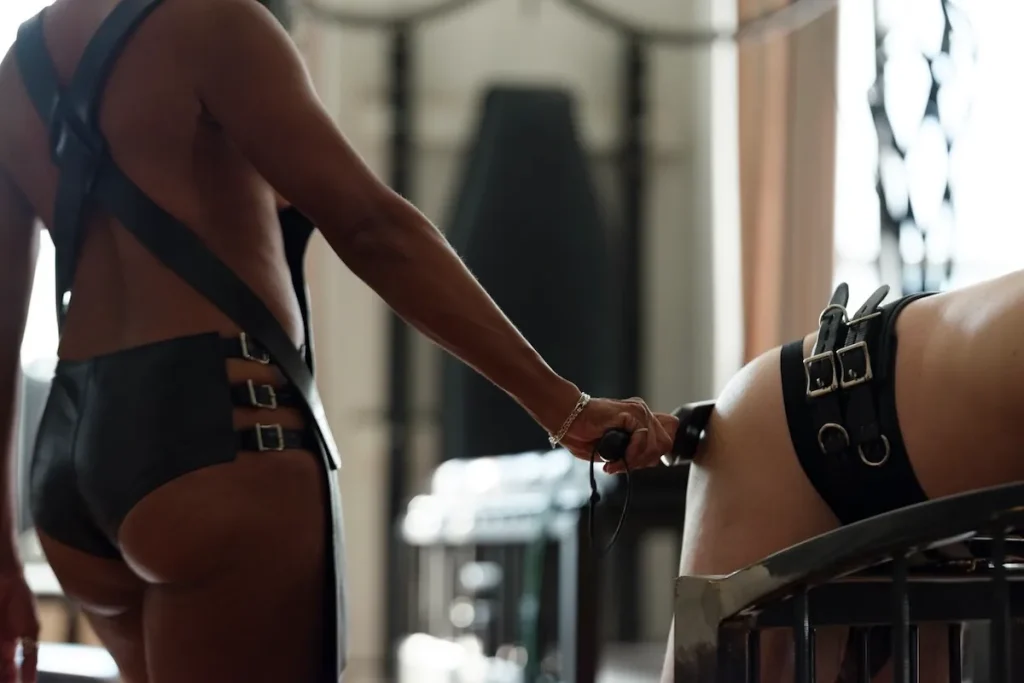
The biggest one is my legacy within the community in terms of how I’ve approached my practice. Specifically, the ways I’ve created and modeled a practice that is, in many ways, unique to me, and therefore created space for other practitioners to create their own practice, not from what they see other people doing, but from what fulfills and is satisfying to them.
They, too, can create a practice that’s unique to them. Everything from their presentation to how they do their business, what they prioritize, and how they define success.
I think how you define success is really important.
CD: What do you want to be known for?
Troy: I’m not the most professionally successful as far as making the most money. Nor am I the most well-known. But I have been able to build a career out of this that continues to be satisfying and sustaining and has given me the things I define success by.
I do work that I love and gives me the resources to have and do things I love outside of work. I have control over my time. I only do sessions that I enjoy, that I want to do. There’s never any point where I say yes to a client just because I need the money.
CD: Right. That is a privilege.
Troy: It is a huge privilege, and it takes a lot of discipline, stability, knowing myself, knowing that it’s okay to say no. Not every session is for me. Not every client is for me. Not every scene is for me.
My practice is satisfying because everything I do is from a place of, “This is what I want. It is what I enjoy. I have chosen this. I’m going to do this my way, and the people who want my way, I want them to find me.”
That’s the legacy that’s most important to me.
I also take joy and pride in having been able to build relationships with certain clients where, in our exchange, in our relationship, they have found the thing that scratched their kink itch, fulfilled their kink fantasies and opened a window or a door to things they maybe didn’t even realize they wanted or needed.
They’ve been able to have a trusted partner with whom to discover that. I think that’s such a beautiful gift to be able to give someone.
I’m grateful for having a legacy with some of my clients with whom we have that connection and that experience we share together. I think that’s huge.
CD: It sounds like your legacy, if I may, in summation, is about inspiration. Not just of your peers, you inspire your subs independently for themselves. You definitely inspire me.
Tell us where we can find you.
Troy: I can be found almost all over the internet as Troy Orleans.
CD: Google you!
Troy: Yes. If you Google “Troy Orleans” in quotes, because if you just Google Troy Orleans, you get a lot of this trombone player in New Orleans.
CD: So close, yet so far.
Troy: Yes. I’m a big fan of his work, though. Troy Andrews, better known as Trombone Shorty in New Orleans. He’s a great musical artist and performer.
But as far as BDSM in general and bondage in particular, my website is Troy Orleans.com. Instagram, @Troy Orleans. Bluesky, Troy Orleans. FetLife, Troy Orleans.
My primary practice is in New York City, but I also have a play space in Miami, and I do travel. You can fly me to you! I have a passport and a very well-curated, portable travel bag.
In terms of my practice and seeing clients, particularly when it comes to travel, I like to have a holistic experience, too. By holistic, I mean that I love being a kinky companion.
It’s not just that I come in and we spend all the time in your hotel room doing bondage. I have a wide array of interests, and it’s experiential. I used to cook and eat professionally.
CD: You can eat professionally?
Troy: I ate professionally! Yes, I did. I was a food writer in my previous occupation. I love film, books, journalism, theater, and all kinds of live music.
I ski, I scuba dive, I play pickleball, I hike, I sail. There’s a lot of fun we can have together.
CD: All I can think of, oh my God, is, have you seen the ’90s movie What About Bob? with Bill Murray? Where he’s tied to the mast, and he’s like, “I’m sailing!” That’s what I see in your future.
It’s Bob-The-Sub Sailing.
Troy: I have a domme friend who is also a licensed captain. We keep talking about chartering a boat and having it be a bondage cruise so we can tie people on the boat.
I want to manifest that shit. That would be so much fun.